


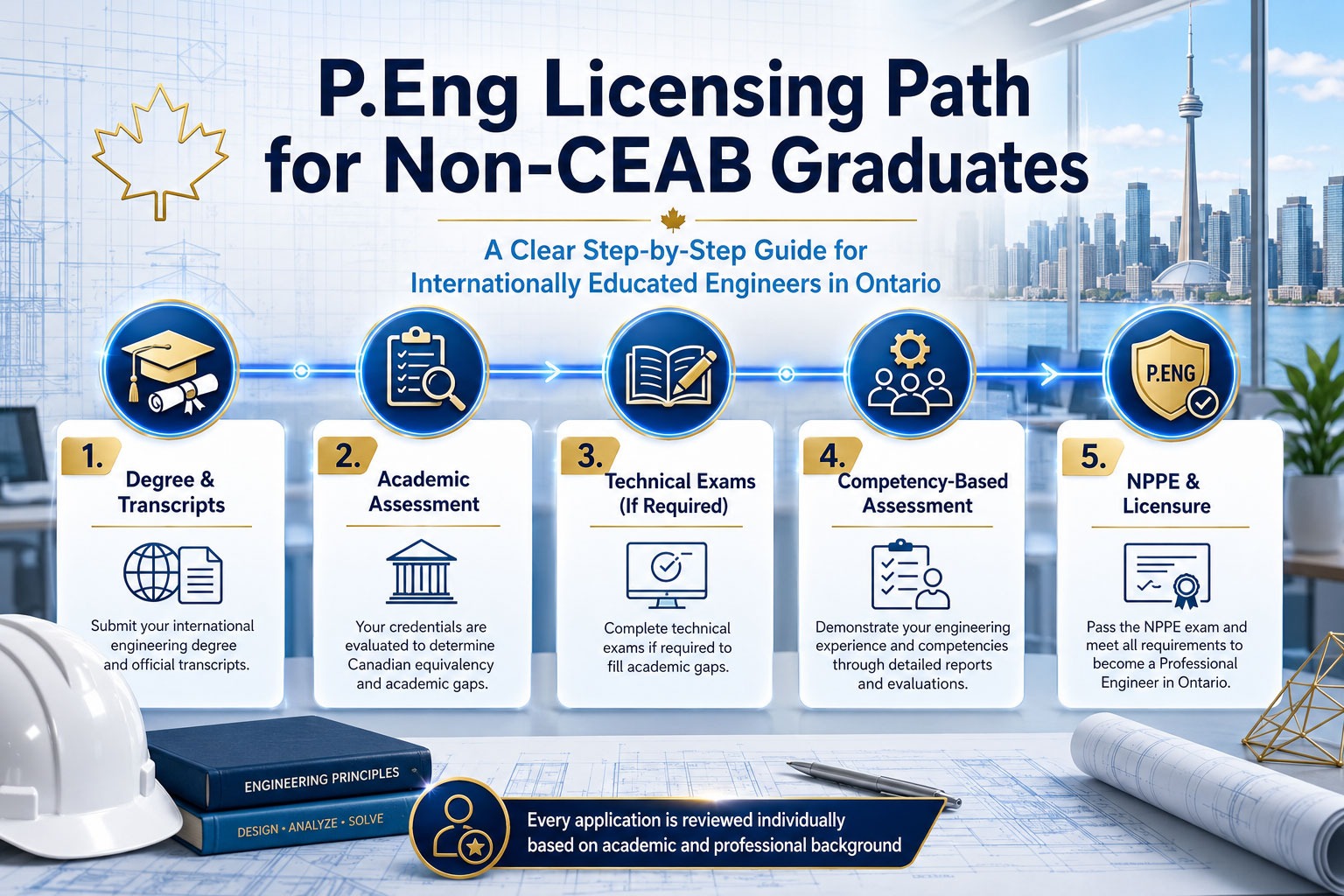
To pursue an Ontario P.Eng. licence with a non-CEAB degree, first confirm your academic eligibility through PEO’s portal. Graduates outside Canada and the U.S. need a WES ICAP Course-by-Course report sent to PEO. Non-CEAB applicants must meet PEO’s technical-exam requirement, pass the NPPE, satisfy identity and good-character checks, and document two years of eligible engineering experience through the CBA.
If you are just starting your journey, we recommend reading Professional Engineer (P.Eng) Licensing in Ontario to understand the overall licensing framework. If PEO has assigned you technical examinations, our guides on P.Eng Technical Exams, eProctor P.Eng Technical Exams, and P.Eng Technical Exams Registration will help you prepare for the next stage of your application.
Unlike CEAB-accredited graduates, applicants from non-CEAB programs undergo an individualized assessment based on their academic background, engineering discipline, and supporting documentation. The exact requirements therefore vary from one applicant to another, making it essential to understand how the evaluation process works before submitting your application.
What Does "Non-CEAB Graduate" Mean?
A non-CEAB graduate is an engineer whose bachelor's degree was not obtained from a Canadian engineering program accredited by the Canadian Engineering Accreditation Board (CEAB).
This category generally includes:
- Engineers who completed their education outside Canada.
- Graduates of engineering programs that are not CEAB accredited.
- Engineers who earned their degree before accreditation was granted.
- Applicants with international engineering qualifications recognized through individual academic assessment.
Professional Engineers Ontario evaluates these applications individually instead of applying a single standard to every candidate. Your education, transcripts, engineering curriculum, institution, and supporting documents are reviewed to determine whether your academic qualifications are substantially equivalent to Canadian engineering standards.
Applicants can learn more about the academic assessment process through the PEO Licensing Process, the Academic Requirements guidelines, and the official Engineering Accreditation information published by Engineers Canada.
Understanding the P.Eng Licensing Path in Ontario for Non-CEAB Graduates
Although every application is unique, the licensing process generally follows the same overall structure. The goal is to determine whether an internationally educated engineer possesses the academic knowledge, professional competencies, and ethical understanding expected of licensed Professional Engineers in Ontario.
| Requirement | What applicants need to do |
|---|---|
| Confirm eligibility | Complete PEO’s “Am I ready to apply?” survey and check whether your degree program is on PEO’s Recognized Programs List. If it is not listed, request program verification through the PEO portal. |
| Submit academic documents | Graduates outside Canada and the U.S. need a WES ICAP Course-by-Course report sent directly to PEO. Start the PEO portal application and confirm academic eligibility before requesting the report. |
| Complete technical exams | The standard non-CEAB requirement is four exams: two Group A, one Group B and one Complementary Studies exam. Eligible first-time exam takers may qualify for a waiver of the remaining two after scoring at least 65% on two eligible, same-discipline exams in their first sitting. |
| Complete the experience requirement | Pass PEO’s Competency-Based Assessment and document at least two years of eligible, verifiable engineering experience. Canadian work experience is not required. |
| Complete remaining requirements | Pass the NPPE and complete the identification and Good Character requirements before submitting the P.Eng. application. |
Academic Assessment for Non-CEAB Graduates
PEO requires non-CEAB applicants to meet its academic requirements, including the technical-exam requirement. The standard program includes four exams: two Group A exams, one Group B exam and one Complementary Studies exam. Applicants whose degree program is not listed should request program verification through the PEO portal. Eligible first-time exam takers may qualify for PEO’s Good Performance policy, which can waive the remaining two exams.

Experience Requirement: Competency-Based Assessment
Applicants must document at least two years of eligible, verifiable engineering experience and pass PEO’s Competency-Based Assessment. The assessment covers 34 competencies in seven categories. Canadian experience is not required. Two years is the minimum time requirement; PEO says many applicants need three to four years to demonstrate all required competencies.
Will You Need P.Eng Technical Exams?
One of the most common questions asked by internationally educated engineers is whether they must write P.Eng Technical Exams.
The answer depends entirely on the results of the academic assessment.
Some applicants receive direct confirmation that their academic qualifications satisfy Ontario's requirements.
Others are assigned P.Eng Technical Exams to demonstrate competency in specific engineering subjects identified during the academic review.
In recent years, PEO has modernized its licensing system, and many applicants now receive fewer assigned examinations than under previous assessment models. However, technical examinations have not disappeared entirely and continue to play an important role for applicants whose academic background requires further verification.
If technical exams are assigned, applicants should review:
- P.Eng Technical Exams
- P.Eng Technical Exams Registration
- eProctor P.Eng Technical Exams
- Technical Examination Program
- P.Eng Technical Exam Study Resources
These resources explain examination registration, preparation strategies, online proctoring, and subject-specific guidance.
The National Professional Practice Examination (NPPE)
Regardless of whether technical examinations are required, All applicants must pass the NPPE before submitting a P.Eng. application. PEO does not accept applications without a completed NPPE.
Unlike technical examinations, the NPPE does not test engineering calculations or technical theory.
Instead, it evaluates knowledge of:
- Engineering ethics
- Professional responsibility
- Canadian engineering law
- Professional practice
- Public safety
- Legal obligations of Professional Engineers
The NPPE ensures that every licensed engineer understands the ethical and legal responsibilities associated with practicing engineering in Canada.
More information can be found through the official National Professional Practice Examination (NPPE)
Common Mistakes That Delay the P.Eng Licensing Path in Ontario for Non-CEAB Graduates
Many internationally educated engineers assume that obtaining a Professional Engineer licence is simply a matter of submitting an application and waiting for approval. In reality, the P.Eng licensing path in Ontario for non-CEAB graduates requires careful preparation at every stage. Even minor errors can extend the licensing process by several months.
The most common reason applications are delayed is incomplete documentation. Missing transcripts, unofficial academic records, untranslated documents, or inconsistencies between personal information and educational records often result in additional requests from Professional Engineers Ontario (PEO).
Another frequent mistake is underestimating the importance of the Competency-Based Assessment. Many applicants focus exclusively on their years of engineering experience, while PEO evaluates how applicants demonstrate engineering judgment, technical decision-making, communication skills, project management, and public safety responsibilities. Providing clear examples supported by measurable outcomes significantly improves the quality of competency submissions.
Applicants who are assigned P.Eng Technical Exams sometimes postpone registration until the final deadline. Delaying registration can reduce the amount of preparation time available and may postpone overall licensing if the next examination session is several months away.
Practical Tips to Complete the P.Eng Licensing Path in Ontario for Non-CEAB Graduates Faster
Although processing times vary depending on each applicant's circumstances, there are several practical strategies that can help you move through the licensing process more efficiently.
- Prepare official academic transcripts and supporting documents before opening your application.
- Review your engineering curriculum and course descriptions in case PEO requests additional academic information.
- Begin documenting your engineering competencies while waiting for your academic assessment.
- Monitor your email regularly for requests from PEO and respond promptly.
- If assigned P.Eng Technical Exams, begin studying immediately rather than waiting for the examination date.
- Familiarize yourself with eProctor P.Eng Technical Exams if your exams will be delivered online.
Applicants who proactively prepare each stage often experience a much smoother licensing journey than those who wait until deadlines approach.
Why Understanding the Entire Licensing Process Matters
For internationally educated engineers, becoming licensed is far more than meeting a regulatory requirement. A Professional Engineer licence represents professional credibility, expanded career opportunities, greater earning potential, and the legal authority to take responsibility for engineering work in Ontario.
Many employers prefer or require engineers who are licensed or actively progressing toward licensure. Understanding every stage of the P.Eng licensing path in Ontario for non-CEAB graduates allows applicants to make informed decisions, avoid unnecessary delays, and develop a realistic timeline for achieving their professional goals.
It is also important to recognize that Ontario's engineering licensing system continues to evolve. Recent changes to academic assessments, competency evaluations, and technical examination requirements demonstrate PEO's ongoing efforts to modernize the licensing process while maintaining high professional standards. Staying informed through official PEO announcements ensures applicants always have access to the latest requirements.
Conclusion
The P.Eng licensing path in Ontario for non-CEAB graduates may appear complex at first, but it becomes much more manageable when broken into clear, sequential steps. From academic assessment and competency evaluation to P.Eng Technical Exams, the National Professional Practice Examination (NPPE), and final licensing approval, each stage is designed to ensure that engineers meet Ontario's professional standards.
For internationally educated engineers—especially those beginning their careers in Canada—the key to success is preparation. Understanding the licensing process early, organizing documentation, preparing for technical assessments when required, and following official PEO guidance can significantly reduce delays and improve your overall experience.
Whether you are still evaluating your eligibility or have already started your application, investing time in understanding the complete licensing pathway will help you move confidently toward earning your Professional Engineer (P.Eng) designation and advancing your engineering career in Ontario.
Frequently Asked Questions (FAQ)
- Do all non-CEAB graduates need to complete technical exams?Yes. The standard PEO requirement is four technical exams. Eligible first-time exam takers may qualify to have the remaining two waived under PEO’s Good Performance policy.
- Is two years of experience enough to get a P.Eng. licence?Two years is the minimum experience requirement, not an automatic guarantee of licensure. Applicants must also pass the Competency-Based Assessment and demonstrate the required competencies.
- Is Canadian work experience mandatory?No. PEO does not require Canadian experience, but the work experience submitted must meet its eligibility and competency requirements.
- How long does the P.Eng. process take?The time needed to complete academic, examination and experience requirements varies. After receiving a complete application, PEO aims to issue a registration decision within six months for 90 per cent of applicants.
